Astrology did not begin as a separated discipline floating far away from astronomy. The ancient skywatcher was observing the heavens and asking two questions at once: What is happening up there, and what does it mean down here?
That matters, because modern students often want to skip straight to interpretation. They want to know what Venus means in love, what Pluto means in crisis, and whether Saturn is about to humble them in public. I understand the impulse. Interpretation is the seductive part. But if you want to understand astrology with depth, then you need a working relationship with the architecture of the solar system. Symbolism does not emerge in a vacuum. It emerges from movement, order, visibility, rhythm, proximity, and scale.
Most people know less astronomy than they think they do. They know the names of the planets, they know Pluto was demoted, and after that things get hazy. But astrology is built on the logic of the sky. If you do not understand where these bodies live and how they move, then part of the symbolic system stays flat. The more you understand the structure of the heavens, the more elegant astrology becomes.
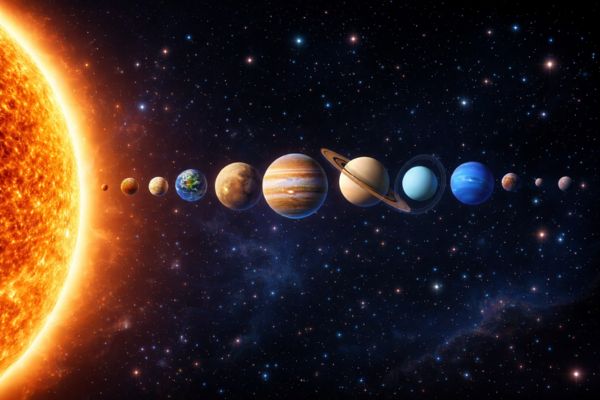
So let’s begin where astrology itself begins: with the order of the solar system.
Why Astronomy Still Matters to Astrology
The Sun is at the center of the solar system, and everything in our celestial neighborhood revolves around it. In astrology, that matters symbolically as much as it does astronomically. The Sun is the organizing principle. It is the source of light, the gravitational center, and the force around which the other bodies arrange themselves. There is no astrology without the Sun because there is no life without the Sun.
Once you begin looking at the solar system as an ordered structure, a pattern appears. The planets closest to the Sun behave differently from the ones farther away. The visible planets speak to one level of human experience, while the telescopic planets open into another. Some bodies move quickly and describe personal life in immediate, intimate ways. Others move so slowly that they shape generations, social systems, and history itself.
The solar system is not just a list of objects. It is a hierarchy of cycles. That hierarchy is part of why astrology works.
Pluto, Eris, and the Question of What Counts
Before we move through the solar system in order, we need to address the celestial family drama that people still cannot let go of: Pluto.
In 2006, the International Astronomical Union created a formal definition of a planet. To qualify, a body had to orbit the Sun, be massive enough to become round, and clear its orbital neighborhood. Pluto failed that last requirement, which led to its reclassification as a dwarf planet. Ceres was reclassified as well, and later Haumea and Makemake joined that category.
Eris helped force that issue. Once Eris was discovered, astronomy had a problem. Either the solar system was about to collect a growing list of new planets, or Pluto’s status had to change. Astronomy chose the latter. It is almost too perfect that an object named after the goddess of strife and discord ended up causing exactly that.
From an astrological point of view, this did not make Pluto irrelevant. Astrology is not built on whether a committee approves of a label. Astrology is built on whether a celestial body functions symbolically and meaningfully in charts, cycles, and human experience. Pluto does. So does Ceres. So does Chiron. And Eris certainly does, whether people are comfortable with her or not.
 The Inferior Planets: Mercury and Venus
The planets between the Earth and the Sun are called the inferior planets: Mercury and Venus. They are called inferior not because they are lesser, but because their orbits lie inside Earth’s orbit. Astrologically, that matters because these planets stay close to the Sun. They are intimately tied to consciousness, identity, and the personal experience of being alive.
Mercury
Mercury circles the Sun in about 88 days and never travels very far from it in the zodiac. That is why Mercury is always in the same sign as the Sun, or the sign directly before or after it.
Astronomically, Mercury is quick, tight, and restless. Astrologically, the symbolism tracks perfectly. Mercury describes thinking, language, perception, learning, communication, movement, and the rapid exchange of information. Mercury is the mind trying to understand what is happening while it is still happening. It stays close to the Sun because thought is one of consciousness’s first tools.
Venus
Venus also remains close to the Sun, though her rhythm is very different. She circles the Sun in about 225 days and never gets too far away zodiacally. Venus does not interpret life the way Mercury does. Venus evaluates it. Mercury says, “This is what it is.” Venus says, “And this is what it means to me.”
Astronomically, Venus is extraordinary. Her rotation is so slow that a day on Venus lasts longer than a Venusian year. Symbolically, that is almost too good. Venus does not rush. Venus lingers. She saturates experience. She turns sensation into preference, attraction, pleasure, desire, attachment, and value. Venus is where experience becomes personal.
Earth and the Moon: The Human Point of View
In Western astrology, we do not place the Earth in the chart because Earth is the vantage point. Astrology is geocentric because human life is geocentric. We read the heavens from where we stand, not from some abstract cosmic neutrality. We are embodied creatures living on Earth, measuring meaning from inside our own conditions of existence.
That perspective matters. The chart is not a god’s-eye view. It is a human view.
Then there is the Moon, Earth’s satellite and the closest major celestial body to us. The Moon circles the Earth in roughly 28 to 29 days, creating the lunar cycle that shapes the rhythm of the month. New Moon, First Quarter, Full Moon, Last Quarter, and back again. The Moon makes time visible.
Astrologically, the Moon describes memory, emotional patterning, instinctive response, and the habits of feeling that live beneath language. The Moon is not theory. The Moon is lived experience. It is the body’s intelligence. It is the part of the psyche that remembers before the mind has formed an explanation.
Because the Moon is so close, it feels immediate. You can see it changing. You can feel its recurrence. That intimacy is part of why lunar symbolism remains so central to astrology.
Mars: The First Superior Planet
Mars is the first planet beyond Earth’s orbit, which makes it the first of the superior planets. This marks an important threshold in astrological thinking. Mercury and Venus stay near the Sun. Mars does not. Mars can oppose the Sun. Mars can stand apart. Symbolically, that matters because Mars is about assertion, separation, action, desire, and will.
Astronomically, Mars has a reddish appearance and takes about 687 days to orbit the Sun. Ancient observers did not need modern science to notice that it looked different from other planets. It looked hot, raw, and blood-colored. It is not hard to see why Mars became associated with battle, aggression, urgency, conflict, and appetite.
In astrology, Mars is the force that cuts, claims, defends, pursues, and initiates. It does not ask for consensus before it acts. It does not wait for everyone to feel comfortable. Without Mars, nothing begins. Nothing resists. Nothing says no. Mars is necessary because life requires force as well as feeling.
The Asteroid Belt and Ceres: The Realm of Fragments
Between Mars and Jupiter lies the asteroid belt, a region filled with rocky bodies and celestial debris. It interrupts the otherwise neat procession of planets, and symbolically that interruption matters. The belt suggests fragmentation, interruption, and complexity. It is not a smooth bridge from personal will to social order. It is a field of pieces.
At the center of this realm, astrologically speaking, stands Ceres.
Ceres is the largest body in the asteroid belt and is now classified as a dwarf planet. In astrology, she speaks to nourishment, care, deprivation, loss, fertility, grief, and the cycle of withholding and return. Ceres is not simply “the mother asteroid.” That flattens her. Ceres is the principle of sustenance and the pain of its disruption. She is what happens when feeding and grieving become part of the same story.
Other asteroids matter as well, especially Pallas, Juno, and Vesta. But Ceres carries special weight because she stands at the threshold between growth and absence, abundance and famine, attachment and separation.

Jupiter and Saturn: The Social Planets
Beyond the personal planets and the asteroid belt, we move into the realm of Jupiter and Saturn, often called the social planets. That phrase does not mean social in the shallow, performative sense. It means that these planets describe the interface between the individual and the systems that organize collective life. They govern culture, institutions, law, morality, status, structure, opportunity, and shared reality.
Jupiter
Jupiter is the largest planet in the solar system and takes nearly 12 years to orbit the Sun, spending about a year in each sign. In astrology, Jupiter is associated with growth, meaning, faith, opportunity, wisdom, abundance, and expansion.
Astronomically, Jupiter’s massive gravitational field helps absorb or redirect debris that might otherwise threaten the inner planets. Symbolically, that protective quality is hard to ignore. Jupiter enlarges, yes, but it also stabilizes. It gives perspective. It opens possibility. It helps life feel like it can become more than mere survival.
At its best, Jupiter brings confidence, generosity, hope, and vision. At its worst, it brings inflation, excess, and grandiosity. Either way, Jupiter wants life to become bigger.
Saturn
Then there is Saturn, the planet people learn to respect once life starts enforcing consequences.
Saturn takes about 29 to 30 years to orbit the Sun, which is why the Saturn return arrives around ages 29 and 58. In traditional astrology, Saturn is the great malefic, but that title is often misunderstood. Saturn is not “bad” because it is evil. Saturn is difficult because reality has limits, and time always collects.
Astronomically, Saturn is most famous for its rings, and the symbolism is almost embarrassingly elegant. Saturn defines. Saturn contains. Saturn creates boundaries, form, edges, and structure. Saturn is also the last planet visible to the naked eye, which gave it a special symbolic role in ancient astrology. It marked the edge of the visible world. Beyond Saturn lay the unknown.
Astrologically, Saturn governs discipline, responsibility, effort, fear, endurance, aging, law, and consequence. Saturn is not here to be liked. Saturn is here to make things real.
Chiron and the Centaurs: Threshold Bodies
Chiron was discovered in 1977 and became the first recognized member of a class of objects known as centaurs. These bodies move in unstable, transitional orbits through the outer solar system, often crossing planetary boundaries. Chiron itself moves between Saturn and Uranus.
That location is symbolically brilliant.
Saturn represents order, limitation, and structure. Uranus represents rupture, innovation, rebellion, and awakening. Chiron lives between them, which is part of why it has become associated with wounding, healing, apprenticeship, skill, and the painful intelligence born from contradiction.
Chiron is not sentimental. It is not a hashtag about healing. It is the place where life exposes a fracture that forces consciousness to evolve. It describes the strange territory where pain becomes knowledge, and where what cannot be fixed in a simple way can still become meaningful, useful, and transformative.
Other centaurs matter too, including Nessus and Pholus, but Chiron remains the most widely used because it introduces astrologers to a threshold form of symbolism. Chiron belongs to the in-between.
Uranus and Neptune: The Transpersonal Planets
With Uranus and Neptune, we enter a different order of reality. These planets move too slowly to describe ordinary daily moods. They belong to collective shifts, generations, eras, and the vast movements of consciousness that reshape culture and history.
Uranus
Uranus was discovered in 1781 through a telescope and was the first planet discovered in modern times. That matters symbolically. Uranus enters astrology alongside revolution, science, upheaval, awakening, experimentation, and the breaking open of old systems.
Astronomically, Uranus takes 84 years to orbit the Sun and has an extreme axial tilt. It is a planet that literally does not orient itself in a conventional way. Of course astrology associates it with disruption, individuation, rebellion, innovation, and shock. Uranus does not continue the existing pattern. Uranus breaks it.
Uranus doubled the size of the known solar system at the time of its discovery. Symbolically, it announced that the map had been too small all along.
Neptune
Neptune was discovered in 1846 and takes about 165 years to orbit the Sun. It spends roughly 14 years in each zodiac sign. Its blue coloration, along with its mythic name, naturally linked it with the sea and all that the sea suggests: vastness, beauty, dissolution, longing, danger, transcendence, and disorientation.
In astrology, Neptune governs dream, spirituality, fantasy, vision, inspiration, glamour, projection, idealization, and illusion. Neptune is the force that makes life feel enchanted, meaningful, or holy. It is also the force that makes human beings lie to themselves in beautiful language.
Neptune dissolves edges. Sometimes that feels like grace. Sometimes it feels like confusion. Usually it is both.
Pluto and the Dwarf Planets: Power Beyond Respectability
Pluto was discovered in 1930 and remains one of the most potent bodies in astrology, regardless of what astronomy now calls it. It has an eccentric orbit, sometimes travels closer to the Sun than Neptune, and takes about 248 years to circle the Sun. Because of its unusual orbit, Pluto does not spend equal time in each sign.
Astrologically, Pluto is associated with power, death, compulsion, exposure, destruction, obsession, survival, and transformation. Pluto does not care about appearances. It cares about what lies underneath them. It strips away what is false, unsustainable, rotten, denied, or no longer viable. Pluto is the part of life that does not respond to politeness.
Beyond Pluto lie other dwarf planets, including Haumea and Makemake. Whether every astrologer works with them is another question, but their existence reminds us that astrology is not frozen in time. The sky continues to reveal itself, and symbolic systems evolve accordingly.
Astrology is not weakened by that. It is deepened by it.
Eris: The Trouble No One Wanted to Name
Then we arrive at Eris.
Discovered in 2005 and named after the goddess of strife and discord, Eris takes more than 500 years to orbit the Sun. Her discovery pushed astronomy into the Pluto debate, which already tells you something about her symbolism.
Eris does not merely create conflict. Eris reveals the conflict that was already there but had been excluded, denied, or managed through fragile politeness. In myth, Eris throws the apple. In life, Eris exposes the vanity, rivalry, exclusion, outrage, and destabilizing truths that people would rather keep hidden behind a more socially acceptable story.
In modern astrology, especially mundane astrology, Eris has become increasingly relevant because we are living through eras defined by identity conflict, ideological fracture, public grievance, social antagonism, and the collapse of false consensus. Eris does not make things comfortable. She makes them impossible to ignore.
The Symbolism Is Not Random
This is the piece people miss when they dismiss astrology too quickly.
The symbolism is not arbitrary. It is patterned.
Mercury stays close to the Sun, and so it describes the mind close to consciousness. Venus stays close too, but with a different rhythm, which is why she describes value, attraction, and attachment rather than interpretation. Mars stands apart and acts. Jupiter enlarges the social field. Saturn defines the boundary of visible order. Chiron bridges structure and breakthrough. Uranus breaks the map. Neptune dissolves it. Pluto drags us below the surface. Eris exposes the conflict embedded inside the system itself.
These meanings are not random slogans someone pulled out of a mystical grab bag. They emerge from astronomical behavior, observation, mythic association, and centuries of symbolic refinement.
That is one of the reasons astrology has survived for so long. At its best, astrology is not lazy mysticism. It is symbolic intelligence rooted in a profound relationship with the visible sky.
Final Thoughts
You do not need to become an astronomer to practice astrology well. But you do need respect for the physical heavens. You need to understand that astrology comes from observing motion, distance, brightness, visibility, cycles, and repetition. It comes from paying attention.
The sky is not random, and neither is astrology.
If you want to read a chart with real depth, then it helps to know the stage before you start interpreting the actors.