There is something magnificently arrogant about planetary magic. For centuries, human beings have looked toward the heavens, contemplated the gods who supposedly govern their circumstances, and decided that observing their influence wasn’t nearly enough. The Gods want an audience. But people want results. Traditional astrologers developed elaborate methods for interpreting the intentions of the heavens, but practitioners of planetary magic entertained a more audacious possibility: perhaps the forces governing human experience could be approached, petitioned, and persuaded. If Venus governs love, why should we remain passive when our relationships are falling apart? If Jupiter presides over prosperity, why shouldn’t we ask for a little more of it? And if Saturn insists upon making life difficult, surely there must be some way to negotiate with the old bastard.
Of course, this raises an inconvenient question that magical practitioners don’t always enjoy confronting. What happens when the person making the request is also contributing to the circumstances they desperately want to change? A ritual may be directed toward attracting love, but what if the magician remains emotionally invested in rejection? What if the person petitioning Jupiter for prosperity has built an entire identity around never having enough? The gods might be perfectly willing to cooperate, but the human being standing before the altar may have other ideas. And some of them may be rather self-defeating.
These questions get to the heart of planetary magic, a practice that has fascinated astrologers, philosophers, and occultists for centuries. Beneath the elaborate ceremonies and mysterious symbols lies an enduring human ambition: to participate in shaping our circumstances rather than surrendering entirely to whatever fate has in store. Whether we approach the planets as spiritual intelligences, divine archetypes, or forces reflected within the human psyche, planetary magic invites us into a relationship with powers that traditional astrology has spent thousands of years attempting to understand.
 What Is Planetary Magic?
Planetary magic is the practice of working with the seven classical planets—the Sun, Moon, Mercury, Venus, Mars, Jupiter, and Saturn—to influence particular conditions or experiences in our lives. Each planet possesses traditional associations that extend into nearly every area of human activity, from love and money to conflict, ambition, illness, and the pursuit of knowledge. Practitioners use these associations to select appropriate rituals, materials, and astrological conditions for the outcomes they hope to achieve.
The distinction between astrology and planetary magic is important, although the two disciplines have been intertwined throughout much of their history. Astrology provides a system for interpreting planetary influences and understanding their relationship to earthly affairs. An astrologer might examine Jupiter’s condition in a birth chart to evaluate questions of prosperity or study an approaching Saturn transit to anticipate a period of increased responsibility. Planetary magic takes that knowledge and asks what we might actually do with it. If Jupiter signifies prosperity, perhaps we can work with Jupiter to improve our financial circumstances. If Mars governs conflict, perhaps its influence can be enlisted to strengthen our courage or defend us against an adversary.
This approach assumes that the planets possess qualities that can be engaged through magical practice. Depending on the tradition, planetary forces may be understood as divine beings, spiritual intelligences, or powers operating through the natural world. Rituals involving candles, talismans, petitions, and invocations provide methods for establishing a relationship with those forces. Astrological timing determines when a particular working may be most effective, while planetary correspondences identify the materials traditionally associated with the desired influence.
Planetary magic is sometimes confused with contemporary manifestation practices, particularly those promising that positive thinking will attract whatever a person desires. Traditional planetary magic is considerably more complicated. The classical planets have distinct temperaments, and their influence is not always pleasant. Mars can provide courage while also governing violence and destruction. Saturn may establish security through restrictions that are initially uncomfortable. Even Venus, whose reputation has benefited enormously from her association with romance, can entangle people in pleasures and attachments that eventually become destructive. Working with the planets requires some appreciation of their character, including the qualities we might prefer to ignore.
As Above, So Below: The Philosophy Behind Planetary Magic
To understand why anyone believed planetary magic could work, we need to enter a worldview in which the heavens and Earth were intimately connected. Ancient and medieval thinkers frequently regarded the world as an ordered system of correspondences, with celestial bodies participating in the organization of earthly life. The planets were associated with particular metals, plants, colors, animals, and human experiences because these things were believed to share underlying qualities.
This philosophy is closely associated with the Hermetic principle commonly expressed as “as above, so below,” a formulation derived from the Emerald Tablet, one of the most influential texts in the history of Western alchemy. The relationship between the celestial and terrestrial worlds suggested that events occurring on different levels of existence could reflect a shared order. For practitioners of planetary magic, these correspondences offered a way to engage with celestial influences through objects and activities here on Earth.
Consider the traditional relationship between Venus and copper. Venus also governs beauty, affection, pleasure, and the desire to establish harmonious relationships. Within the magical worldview, these associations form part of a coherent symbolic pattern. A Venus talisman fashioned from copper was therefore understood to possess a particular affinity with the planet, especially when created under appropriate astrological conditions. The material was selected because it participated in the larger system of correspondences through which Venusian influence was believed to operate.
These ideas were developed in texts such as the Picatrix, a medieval work of astrological magic that emerged from the Arabic intellectual tradition and later circulated in Latin Europe. The Picatrix describes elaborate methods of constructing talismans, selecting astrological conditions, and engaging planetary powers for specific purposes. Centuries later, Heinrich Cornelius Agrippa gathered an enormous body of magical philosophy into his Three Books of Occult Philosophy, examining the relationships among the natural world, celestial influences, and spiritual realities.
Alchemy also contributed to the development of planetary symbolism. Although its practitioners were famously preoccupied with the transformation of metals, alchemy eventually acquired broader philosophical and spiritual interpretations. The process of transformation became an important metaphor for changes within the human being, an association that would later attract the attention of psychologist Carl Jung.
What makes these traditions fascinating is the seriousness with which their practitioners approached the relationship between human intention and celestial power. Planetary magic required knowledge of astrology, an understanding of symbolic correspondences, and considerable attention to ritual procedure. The magician was expected to understand the power being approached and the conditions under which that approach might succeed.
The Seven Classical Planets: A Rather Dysfunctional Divine Family
The planets of traditional magic are hardly a collection of agreeable celestial benefactors waiting to fulfill our wishes. Their mythological personalities reflect the contradictions of human experience, and understanding those contradictions is essential to appreciating their magical significance.
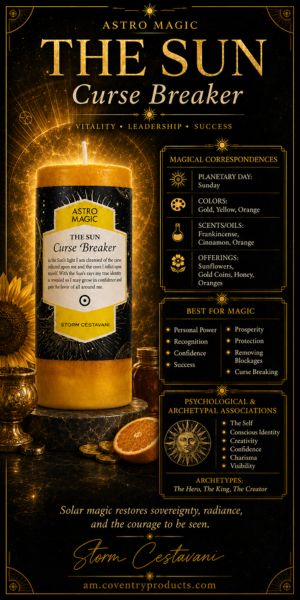
The Sun governs vitality, personal authority, recognition, and success. Solar magic traditionally concerns the cultivation of influence, confidence, and the ability to occupy a position of leadership. Yet the Sun also invites uncomfortable questions about pride and the need to be seen. Someone seeking recognition may discover that their desire for admiration has become inseparable from their sense of personal worth.
The Moon presides over emotional life, protection, domestic concerns, dreams, and the fluctuating conditions of human experience. Lunar magic may be employed for emotional security, intuition, or matters involving family and home. Psychologically, however, the Moon also reveals how fiercely people can cling to familiar patterns, even when those patterns have become sources of misery. The need for security sometimes develops into an unwillingness to change.
Mercury, the messenger and trickster, governs communication, commerce, intelligence, learning, and the ability to navigate complicated situations. Mercurial magic is traditionally used in matters involving business, writing, negotiation, and intellectual pursuits. Mercury’s mythology reminds us that cleverness and deception have always enjoyed a rather intimate relationship. The same mental agility that allows someone to solve a problem can also enable them to rationalize behavior they know perfectly well is questionable.
Venus governs love, beauty, artistic expression, attraction, and pleasure. Venusian magic is among the most recognizable forms of planetary practice because romantic desire has an extraordinary ability to make otherwise sensible people behave irrationally. Although Venus may be approached for affection or reconciliation, her symbolism extends into the complicated territory of personal values, attachment, and the things we believe will make us desirable. The pursuit of love becomes considerably more interesting once we acknowledge that people are not always attracted to what is good for them.
Mars governs courage, competition, conflict, aggression, and the instinct for self-preservation. Martial magic may be undertaken for protection, strength, or victory over opposition. However, Mars also represents the anger many people have been taught to suppress. Someone who consistently avoids confrontation may require a healthier relationship with aggression, while another person may need to recognize how frequently they manufacture enemies to justify their hostility.
Jupiter represents prosperity, wisdom, opportunity, generosity, and the expansion of one’s circumstances. Jupiterian magic traditionally concerns abundance, professional advancement, and favorable outcomes. Its mythology, particularly the rather spectacular appetites of Zeus, also reminds us that expansion without restraint can create problems of its own. Jupiter can encourage confidence and opportunity, but its symbolism also encompasses extravagance, entitlement, and the conviction that ordinary limitations should apply to everyone else.
Finally, Saturn governs boundaries, responsibility, discipline, endurance, and time. Saturnian magic is associated with stability, protection, restrictions, and the establishment of lasting structures. Saturn rarely wins popularity contests because its lessons frequently involve accepting realities we would prefer to negotiate away. Yet its capacity to establish limits can be enormously useful, especially when a situation has become chaotic or when someone needs the discipline to sustain a commitment.
Each planet offers a different approach to human experience, and selecting the appropriate planetary influence requires an understanding of the problem being addressed. Someone struggling with professional confidence might benefit from solar symbolism, while a person who cannot maintain boundaries may find Mars or Saturn more appropriate. The objective determines the planetary relationship, although personal astrology can introduce further considerations.
What Jung Can Teach Us About Planetary Magic
One of the more intriguing developments in modern approaches to planetary magic is the possibility of examining its symbolism through depth psychology. Carl Jung devoted considerable attention to mythology, religion, and alchemy because he believed their images expressed psychological processes that frequently operated beyond conscious awareness. The gods of mythology, from this perspective, can be understood as representations of archetypal patterns that continue to influence human behavior.
This interpretation introduces an additional dimension to magical practice. A ritual directed toward a planetary power may also bring the practitioner into contact with the psychological qualities represented by that planet. Working with Mars, for example, can raise questions about anger and self-assertion, while Venus may expose uncomfortable truths about attraction and emotional dependency.
Consider someone who has spent several years trying to establish a stable romantic relationship. They repeatedly become involved with emotionally unavailable partners, experience the familiar disappointment of rejection, and eventually turn to Venusian magic in the hope of attracting someone capable of genuine commitment. Their petition may be beautifully written, the candle carefully prepared, and the timing selected according to every traditional rule. Yet their romantic history suggests that something more complicated is occurring beneath the conscious desire for companionship.
Perhaps this individual learned during childhood that affection was inconsistent and had to be earned through extraordinary effort. As an adult, the uncertainty of an unavailable partner feels strangely familiar. Pursuing someone who cannot fully reciprocate their feelings allows them to repeat an old emotional drama while remaining convinced that the problem lies entirely with the people they attract. The rejection is painful, but the pattern also protects them from the unfamiliar demands of genuine intimacy.
A Venus ritual does not automatically resolve such a conflict. However, a psychologically informed approach to planetary magic provides an opportunity to examine the relationship between desire and unconscious motivation. The practitioner may begin asking why certain experiences remain so compelling and whether their behavior actually supports the outcome they claim to want.
The implications extend well beyond romantic relationships. Someone performing Jupiter magic for prosperity may discover that financial insecurity has become an important part of their identity. A person seeking solar recognition might simultaneously resent anyone who attracts attention. An individual working with Saturn to establish stability may resist the responsibilities necessary to maintain it.
Jung understood the process of individuation as an encounter with the larger personality, including aspects of ourselves that the conscious ego has neglected or rejected. Planetary symbolism offers a particularly rich language for exploring these conflicts because the gods embody qualities that human beings experience in contradictory ways.
This psychological interpretation does not settle the question of whether planetary spirits exist independently or whether magical rituals can exert supernatural influence over external events. Those remain matters of metaphysical belief rather than established scientific fact. Nevertheless, the traditional magical understanding and the psychological interpretation can inform one another without requiring practitioners to abandon either framework.
What interests me about their intersection is the uncomfortable possibility that our intentions may be considerably less straightforward than we imagine. We approach the planets asking for change while carrying psychological investments in keeping certain aspects of our lives exactly as they are.
How to Practice Planetary Magic
For someone beginning planetary magic, the first consideration is deciding what they hope to accomplish. This sounds deceptively simple, particularly in a culture that encourages people to pursue their desires with very little examination of where those desires originate. Yet a clearly defined intention provides the foundation for selecting an appropriate planetary influence and determining how the working should be approached.
Suppose someone wants to become more assertive at work. They have difficulty expressing disagreement, regularly accept responsibilities that belong to other people, and eventually become resentful when colleagues take advantage of their willingness to accommodate everyone. A Mars working might be appropriate because Mars governs courage, confrontation, and the capacity to defend personal boundaries.
Once the planetary influence has been selected, the practitioner considers timing. Traditional astrology assigns each day of the week to a particular planet: Sunday belongs to the Sun, Monday to the Moon, Tuesday to Mars, Wednesday to Mercury, Thursday to Jupiter, Friday to Venus, and Saturday to Saturn. These associations provide a convenient introduction to planetary timing, although more elaborate workings may require planetary hours or electional astrology to determine an appropriate moment.
The ritual itself can take several forms. Some practitioners create talismans using planetary symbols and traditionally associated materials. Others employ candles, incense, written petitions, devotional prayers, or meditation. Planetary attunement, which involves directing attention toward the qualities of a particular planet, offers another accessible starting point. The methods differ, but each attempts to establish a deliberate relationship with the planetary influence being approached.
For our example involving Mars, the practitioner might choose Tuesday, prepare a red candle according to the symbolism of their tradition, and write a petition requesting courage and the ability to establish appropriate boundaries. During the ritual, they could meditate upon the martial qualities they wish to cultivate, paying particular attention to their emotional relationship with confrontation.
However, the working also raises a practical question. What happens the next time a colleague makes an unreasonable demand? The practitioner still has to decide whether to accommodate the request or respond differently. A magical ritual may reinforce an intention and provide a meaningful spiritual framework for pursuing change, but it cannot relieve someone of the responsibility for their own decisions. Just a pro tip, you might want to read that last sentence again!
More advanced planetary magic introduces additional considerations involving the natal chart, planetary dignity, astrological transits, and electional conditions. A planet’s placement in the birth chart may influence how a practitioner approaches its symbolism, while current planetary conditions can inform the timing and character of a magical working.
Beginners benefit from learning the traditional associations of the seven planets and developing familiarity with simple ritual methods before attempting elaborate ceremonies. Keeping a record of magical workings, including intentions, astrological conditions, psychological observations, and subsequent developments, can help establish a disciplined relationship with the practice.
Can You Really Bend the Planets to Your Will?
The title of my original planetary magic course, Bending the Planets to Your Will, was deliberately provocative. There is something irresistible about the suggestion that we might approach the gods and convince them to cooperate with our ambitions. After all, human beings have spent an extraordinary amount of time pleading with divine powers for assistance, usually while hoping to avoid whatever sacrifices those powers might demand in return.
Yet the question of will becomes considerably more complicated once we examine it psychologically. The conscious ego may believe it knows exactly what it wants, but Jung’s work suggests that the personality contains conflicting motives and unconscious attachments that can undermine those intentions. We may desire freedom while remaining emotionally dependent upon circumstances that restrict us, or crave recognition while fearing the exposure that accompanies success.
The old magical traditions approached the planets with considerable respect for their power and temperament. Practitioners studied astrological conditions, selected materials according to established correspondences, and developed rituals intended to place human intention in relationship with celestial influence. Whether understood spiritually or psychologically, that process demands more than wishing for a preferred outcome.
There is also an ethical dimension that deserves attention. The desire to influence another person’s feelings or decisions can emerge from understandable emotional pain, but magical practice does not eliminate the question of personal responsibility. A Venus working intended to cultivate a healthier relationship raises different considerations from an attempt to force an unwilling former partner to return. The fact that we desperately want something tells us very little about whether pursuing it is wise.
Perhaps this is where the study of planetary magic becomes most interesting. We begin with the intention of influencing the circumstances of our lives, only to encounter questions about the nature of our desires and the assumptions governing our behavior. The planets provide a language through which those questions can be explored, while the magical tradition offers methods for engaging consciously with the forces they represent.
And if we’re going to have the audacity to summon Jupiter, petition Venus, or attempt to negotiate with Saturn, we might as well examine the motives of the person making the request. The gods have complicated reputations, but human beings have hardly demonstrated that ours are any better.