
So, you’ve decided to perform a planetary candle ritual. Perhaps you’ve purchased an Astro Magic candle, studied the correspondences, and selected a favorable planetary hour. You’ve even cleared a little space on your table and assembled everything you think you might need. Now comes the part that seems to make everyone nervous: What the hell are you supposed to do?
If you spend enough time researching magical rituals online, you might conclude that lighting a candle requires the organizational skills of a wedding planner and the ceremonial discipline of a medieval monastery. There are elaborate invocations, complicated purification procedures, specific instructions about which direction to face, and endless warnings about the terrible consequences of doing something incorrectly. Some practitioners insist that a candle must never be extinguished prematurely, while others have very strong opinions about whether you’re permitted to blow out the flame. Apparently, the gods have survived thousands of years of civilization but cannot tolerate someone using the wrong candle snuffer.
 After more than twenty-five years of practicing planetary magic, I’ve developed a rather uncomplicated opinion about most of these concerns: people spend far too much time worrying about the performance of magic and considerably less time thinking about what they’re trying to accomplish.
Traditional methods are important, and I have enormous respect for the magical systems preserved by authors such as Agrippa and the practitioners responsible for the Picatrix. Their work provides a historical and philosophical foundation for understanding how celestial influences were believed to operate through the natural world. However, the traditions also need to be understood within their historical contexts, and not every ritual requires the same level of preparation. Constructing a sophisticated astrological talisman is a different undertaking than performing a simple planetary candle working, and treating the two as though they have identical requirements only makes an accessible practice unnecessarily intimidating.
When I developed the Astro Magic candle line, my intention was to simplify planetary magic by bringing together the correspondences I had studied and used throughout my practice. I wanted people to have a way of approaching the planetary gods without needing to become scholars of Renaissance ceremonial magic before they could begin. That doesn’t mean eliminating the practitioner’s responsibility. In fact, by simplifying the material preparations, I hoped people would devote considerably more attention to the part of the process I consider most important: understanding why they’re performing the working in the first place.
Deciding Whether You Really Want What You’re Asking For
Whenever someone approaches me about purchasing an Astro Magic candle, I generally begin by asking questions. Sometimes the discussion is straightforward. A person wants help with a professional opportunity, hopes to improve their financial circumstances, or needs assistance establishing boundaries in a difficult situation. Other times, what initially appears to be a simple request turns into a considerably more complicated conversation.
Love is a particularly good example. Someone may tell me they want to attract a romantic partner, which would ordinarily suggest a Venus working. But after asking a few questions, I sometimes discover that they’re still preoccupied with a former relationship. Their desire to attract someone new may be less important than their unresolved attachment to someone who is no longer part of their life. If we immediately reach for Venus because the person mentioned love, we may overlook what they actually need.
In these circumstances, I occasionally recommend beginning with a solar or lunar working instead. The Sun can be useful for addressing negative influences, developing personal authority, and helping people reclaim aspects of themselves that have become entangled in previous experiences. I’ve also used solar magic when working with patterns that appear to have persisted through families for generations. The Moon, meanwhile, can be approached for emotional restoration, greater awareness of one’s genuine feelings, and a stronger connection to the body and present circumstances. Someone who continually revisits the emotional experiences of a former relationship may benefit from becoming more conscious of what they’re feeling now, rather than attempting to recreate something that no longer exists.
Within my practice, these are different magical objectives, even though all three might initially be described as wanting a better romantic life. The same principle applies to other situations. Someone hoping to advance professionally might approach Jupiter for opportunity and expansion, but Mars may be appropriate if the immediate problem involves courage or competition. If the person struggles with consistency or needs to establish a more durable professional foundation, Saturn may deserve consideration. The nature of the problem should guide the choice of planet.
When people are working independently, I encourage them to begin with a journal. Write down what you want, explain why you want it, and consider what achieving that objective would actually change in your life. Once you’ve finished, put the journal away and return to it the following day. Read what you’ve written and ask yourself whether it still reflects what you genuinely want.
I’ve found that allowing a little time between the initial desire and the decision to perform magic can be enormously useful. Sometimes a person discovers that an intention was motivated by an immediate emotional reaction. Other times, the desire remains, but the circumstances surrounding it become clearer. If you’re confronting a serious problem, spending a day examining it isn’t an unreasonable request. After all, if you’re not prepared to do the work, why are you doing the magic?
Choosing the Planet and Learning Whom You’re Approaching
Once you’ve clarified your intention, the next consideration is selecting the appropriate planetary deity. In the earlier articles of this series, I’ve explored the traditional powers of the seven classical planets, their mythological personalities, and the correspondences associated with their magical functions. That knowledge provides a foundation for choosing a working, although experience eventually teaches you that the most appropriate planet isn’t always the one you initially expect.
Many years ago, I performed a solar working because I wanted to expand my social circle. I was interested in meeting new people and developing friendships, which might ordinarily suggest Venus or Mercury. Instead, I felt that the Sun was the appropriate deity to approach. What followed was one of the most interesting experiences of my magical practice.
Rather than simply meeting additional people, I lost nearly my entire existing social circle. Over time, however, I developed a new group of friendships that has endured for nearly twenty years. Looking back, I believe that the changes were exactly what I needed, even though they were quite different from what I initially imagined. I had approached the Sun hoping to expand my social life, and I came to understand the experience as a reorganization of my relationships around the person I was becoming.
Apparently, Apollo decided my social life needed an entirely new cast rather than a few additional guest stars.
I’ve thought about that working many times over the years because it helped me appreciate the role of intuition in planetary magic. The Sun is associated with identity, personal power, vitality, and the development of the individual self. Although I initially wondered whether I’d selected the wrong deity, I eventually concluded that the solar symbolism was remarkably appropriate to the changes I experienced. This was also a complex, long-term working involving an important part of my life, rather than something as straightforward as hoping to find a date for Friday night at the club.
Of course, I wouldn’t encourage beginners to disregard traditional planetary correspondences simply because a particular deity happens to appeal to them. Those associations exist for a reason, and learning them helps practitioners understand the powers they’re approaching. But I do believe that intuition becomes increasingly important as someone develops experience with the planets. There may be occasions when a particular deity seems especially appropriate, and investigating that attraction can reveal something significant about the intended working.
These days, I often spend considerable time considering a magical operation before performing it. I’ll examine the situation, think about the planetary influences involved, and sometimes begin speaking with the deity before deciding whether a formal ritual is necessary. I’m considerably less interested in rushing into a working than I was when I first began practicing magic.
I recommend that beginners adopt a similar curiosity. Learn about the planet you’re considering, including its traditional astrological meanings and mythological background. One of my favorite resources is Theoi Greek Mythology, which provides an extensive introduction to the Greek gods, their attributes, and the ancient literature associated with them. Many deities also have surviving hymns and poetic works that can help someone become familiar with their traditional personalities.
You don’t have to become a classical scholar, but knowing something about the deity you’re approaching seems like a reasonable courtesy before asking for assistance.
Writing a Petition That Actually Says Something
Once you’ve chosen your planet, the next step is to write your petition. This is probably the part of candle magic that I wish people would take more seriously, because I’ve encountered countless practitioners who spend considerable time assembling ritual supplies and then rush through the actual request.
Begin with a piece of paper and write down what you want. You can make a straightforward statement, develop a list of the qualities or circumstances you’re hoping to attract, or compose a letter addressed directly to the planetary deity. I sometimes recommend the latter because it encourages people to think about the working as an interaction with a particular god or goddess.
There is no requirement that the petition sound like a ceremonial document locked away in the basement of the Vatican. If you’re accustomed to speaking plainly, there’s nothing wrong with approaching the deity in that manner. You should be respectful, of course, but the gods already know who you are. Attempting to adopt an elaborate personality because you imagine it will secure their favor strikes me as a rather pointless exercise.
What does matter is being specific.
My friend Dorothy Morrison, an author and magical practitioner, has a wonderful way of explaining this. She recommends that if you’re seeking a romantic partner or companion, you should specify that you’re looking for a human being. Otherwise, given the gods’ occasionally twisted sense of humor, you could find yourself with a poodle possessing every admirable quality you requested.
Now, there’s nothing wrong with a poodle. But if you’re hoping to get married, the situation could become rather awkward.
Humor aside, the example illustrates why a petition deserves careful consideration. If you’re seeking a relationship, think about the qualities you want in another person and the kind of relationship you hope to develop. If you’re requesting financial assistance, consider whether you’re asking for increased income, a new opportunity, greater stability, or help resolving an immediate obligation. These objectives may overlap, but they aren’t identical.
I’m also interested in the motivations underlying a petition, particularly when relationships are involved. Someone who wants an estranged partner to return may have perfectly understandable reasons for feeling that way, but fear, loneliness, humiliation, and unresolved attachment can also influence the desire. When these feelings dominate the working, it’s worth considering whether bringing the person back would genuinely improve the situation.
Suppose a woman repeatedly uses magic to draw back a husband who continually leaves the marriage to pursue other relationships. She might achieve a reconciliation, only to discover that his need for attention and validation remains unchanged. Before long, she’s performing another working to bring him home, and then another. The ritual becomes part of the same recurring pattern she was hoping to escape.
I don’t believe it’s my responsibility to dictate what other people are permitted to do with magic. They have their own lives, circumstances, and decisions to make. However, I do encourage them to consider the consequences of what they’re requesting. Within my understanding of magical practice, a working can follow a path of least resistance, and the eventual result may involve circumstances the practitioner didn’t anticipate.
This is one reason I sometimes suggest self-improvement workings before attempting to influence another person. Strengthening someone’s sense of identity or helping them become more conscious of their emotional needs may provide a better foundation for deciding what they genuinely want from a relationship.
There is nothing particularly glamorous about spending an afternoon examining your motives, but I’ve found that the preparation often reveals more about the problem than someone expected. It also gives the practitioner an opportunity to determine whether the petition they’re preparing is something they’re willing to live with if the circumstances begin to change.
Preparing Yourself, Your Candle, and Your Space
Once you’ve completed your petition, preparing for the ritual should be relatively uncomplicated. I recommend beginning by cleaning the space where you’ll perform the working. You don’t need a permanent altar or an elaborate ceremonial chamber, although you’re welcome to create one if that’s how you prefer to practice. A clean, comfortable area where you can concentrate without interruption is perfectly sufficient for a simple planetary candle ritual.
I also encourage people to take a shower beforehand, using the experience as an opportunity to focus on clearing away the emotional residue of the day. It’s a simple way of preparing yourself for the working and establishing a distinction between your ordinary activities and the attention you’re about to devote to the deity.
You may also wish to make an offering. Flowers, herbs, and aromatic substances associated with the chosen planet are among the easiest options, and I generally place an offering on a small plate near the candle. Libations can also be appropriate. The particular material should reflect the planetary correspondences you’ve studied, but there’s no need to construct an extravagant display. The offering is an expression of respect and an opportunity to acknowledge the relationship you’re developing with the deity.
Traditional planetary magic includes numerous associations involving plants, fragrances, metals, colors, and other natural substances. I’ve already explored their significance in Planetary Correspondences: Colors, Metals, Symbols, and Their Meanings, so there’s little reason to repeat the entire subject here. If you’re using an Astro Magic candle, much of the correspondence work has already been incorporated into the candle’s preparation. If you’re using an ordinary candle, you can work with appropriate colors and other materials according to the tradition you’re following.
Whatever materials you select, remember that ritual safety is more important than historical imitation. Toxic substances have no place in casual magical preparations, and herbs, flowers, incense, oils, or offerings should be kept away from an open flame. The candle belongs on a stable, heat-resistant surface where it can burn safely under supervision.
Once everything is arranged, you’re ready to begin.
Performing the Candle Ritual
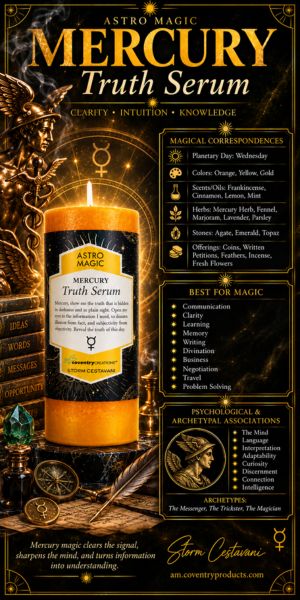 The actual procedure I recommend is simple enough that someone performing their first planetary candle working should be able to follow it without difficulty.
Begin by approaching the planetary deity in your own words. You can offer a greeting, explain why you’ve chosen to work with that particular planet, and present any flowers, herbs, or other offerings you’ve prepared. If you’ve written your petition as a letter, you may read it aloud. Otherwise, you can explain your intention conversationally, using the written petition to help maintain your focus.
There is no requirement to deliver an elaborate invocation unless that’s part of the tradition you’ve chosen to follow. Personally, I encourage people to approach the gods much as they would anyone else with whom they hope to establish a meaningful relationship. There’s nothing wrong with expressing admiration, appreciation, or respect, but pretending to be someone you’re not is unnecessary.
After presenting your petition, spend a couple of minutes imagining the result you hope to achieve. Picture the circumstances you want to experience and consider what accomplishing your objective would look like in ordinary life. Someone seeking professional advancement might imagine receiving a favorable offer or finding themselves in a position that provides greater stability. A person undertaking a solar working could imagine responding to difficult circumstances with greater confidence and personal authority.
You don’t need extraordinary psychic abilities to do this, and you certainly don’t need to produce elaborate mental images worthy of a Hollywood special-effects department. The purpose is to concentrate on the result you’ve identified and give it your attention.
Once you’ve spent a little time with that image, light the candle.
After all, this is planetary magic, not Bewitched. You don’t need to twitch your nose, summon thunder, or arrange for mysterious lights to appear around the room. The preparation, petition, relationship with the deity, and concentration on your objective are the substance of the working. Lighting the candle is the ritual action through which you express that intention.
If you have selected an appropriate planetary day or hour, you can begin the working during that period. As discussed in Planetary Days and Hours: When to Perform Planetary Magic, I regard astrological timing as useful but not something that should prevent a person from addressing an immediate need. You should understand the traditional timing principles and use them when practical without becoming so rigid that an opportunity to act disappears while you’re waiting for a more attractive election.
You may remain with the candle for a while, continue speaking to the deity, or simply reflect upon your petition. I don’t require people to maintain a particular meditative state for the duration of the burning. The candle can continue burning while you’re engaged in other appropriate activities, provided it remains attended and you’re able to supervise it safely.
Extinguishing the Candle and Continuing the Working
This is an area where my practice differs from that of some other magical practitioners. You’ll occasionally encounter instructions insisting that a ritual candle must be extinguished with a snuffer and never blown out. I don’t subscribe to that requirement.
Within my practice, I regard blowing out a candle as symbolically incorporating something of myself into the working. I sometimes describe this as contributing my DNA through my breath, although the significance I’m referring to is magical and symbolic rather than a scientifically established effect upon the ritual. But, there may be a case made for spittle from ones breath to actually be considered DNA.
More importantly, I don’t believe that anyone should leave a candle burning unattended because they’re afraid extinguishing it might interfere with the magic. If you’re leaving the house, going to bed, or unable to supervise the candle, extinguish it safely. Setting your home on fire is a rather dramatic way of discovering that you’ve misunderstood the priorities of planetary magic.
When you’re ready to relight the candle, spend another couple of minutes imagining the result you’re seeking. You can speak to the planetary deity again, repeat your petition if you wish, or simply express gratitude for any assistance you’ve experienced. Then relight the candle and allow the working to continue.
You don’t need to repeat every part of the original preparation unless you find it useful. The working remains connected to the intention you’ve already established, and I consider it complete when the candle has finished burning.
Afterward, I generally recommend disposing of the cooled remains safely. There is one exception I make for certain Saturnian workings involving binding, restriction, or protection. In those situations, I recommend placing the remains in a paper bag and discarding them in an appropriate trash receptacle outside the home. Removing the materials from the house provides a physical gesture that reinforces the intention to establish a boundary or limit an unwanted influence.
It’s a practical expression of the working’s symbolism, and it doesn’t require an elaborate disposal ceremony.
Long-Term Workings and the Significance of Three Candles
Not every magical objective can reasonably be expected to develop within a few days. Some situations involve longstanding difficulties, major life changes, or circumstances that require sustained attention. In those cases, I sometimes recommend performing a series of three candle workings, burning the candles one after another rather than simultaneously.
The number three has appeared in numerous religious and magical traditions, often representing completeness or an organized whole, although its specific meaning varies according to the system involved. As a tarot reader, I also appreciate the symbolism of the Empress, numbered III in the Major Arcana. Her associations with abundance, fertility, cultivation, and growth offer an interesting parallel to the idea of nurturing an intention through repeated magical activity.
With three candles, the practitioner has an opportunity to continue engaging the planetary deity while maintaining attention on the objective. Complete the first candle, move to the second, and then undertake the third working. The overall intention may remain the same, although the practitioner may discover additional information about the situation as the process unfolds.
I particularly recommend this approach when the intention involves circumstances that are unlikely to change overnight. My solar working concerning friendships, for example, involved a major reorganization of my social life. The relationships that emerged developed over time, and their enduring significance became apparent through the years that followed. It would have been rather unrealistic to expect an undertaking of that magnitude to produce a completed new social circle before the weekend. Although at the time, I wish it did!
One of the additional benefits of extended planetary work is the opportunity to develop an ongoing relationship with the deity. I encourage people to speak with the planetary gods regularly, even when they’re not performing formal rituals. You can discuss what’s happening in your life, acknowledge difficulties, express gratitude for assistance, or simply maintain contact with a deity you’ve come to know through your practice.
I don’t believe these conversations need to become formal ceremonies, nor do I think every expression of gratitude requires another offering. If you want to make an offering, there’s nothing wrong with doing so, but the relationship shouldn’t become an endless series of ritual obligations.
You’re developing a relationship with the planet, not preparing a holiday dinner.
The gods have personalities and histories, and the more familiar you become with them, the easier it may be to approach them naturally. Continued study, regular conversation, and personal experience can all contribute to that familiarity.
Evaluating the Results of Your Working
People often become unnecessarily anxious about determining whether a candle ritual has been successful. They watch the flame, examine the wax, and search for extraordinary signs that their petition has been received. Some seem convinced that the gods will provide a dramatic announcement confirming that their magical request has been approved.
Personally, I find it more useful to pay attention to what’s happening in the area of life you were attempting to influence. You don’t need a burning bush descending from the heavens to announce that your magic is complete.
If you’ve performed a Jupiter working for professional advancement, examine whether opportunities are beginning to emerge. If you approached the Sun because you wanted greater confidence or a change in your personal circumstances, consider how your behavior and experiences have developed. The question is whether the objective you identified in your petition is becoming part of your life.
I generally recommend allowing approximately one lunar cycle, or about twenty-eight days, before reaching a conclusion about a relatively straightforward working. That’s a practical guideline drawn from my experience, not an absolute deadline imposed by the gods. Some intentions involve processes that naturally require more time.
Financial improvement is an obvious example. Someone undertaking a long-term Jupiter working may notice incremental developments rather than a sudden transformation. A professional opportunity may appear, responsibilities may change, or circumstances may gradually become more favorable. These developments can be considered in relation to the original petition without assuming that every pleasant coincidence is evidence of magical intervention.
For more complex workings, I think keeping a journal is worthwhile. Record the intention, the deity approached, the timing, and the circumstances surrounding the ritual. As events develop, you can return to those notes and examine what actually happened. This also makes it easier to recognize when an intention needs to be reconsidered rather than simply repeating the same working out of frustration.
And remember that engaging in planetary magic doesn’t relieve you of the responsibility to participate in your own life. If you’re performing a Jupiter working for employment, you should probably continue looking for work. If you’re seeking stronger personal boundaries through Saturn, practical decisions about the people and situations you permit into your life remain important. A magical ritual may express your intention, but it shouldn’t become an excuse to avoid the ordinary actions necessary to pursue it.
After twenty-five years of practice, I’ve become convinced that the preparation, choices, and willingness to engage with the circumstances surrounding a working are essential parts of the experience. There is little sense in asking the gods for assistance while refusing to do anything that might help bring about the desired result.
Your Ascendant Ruler and the Planetary Relationship That Lasts a Lifetime
Although most people initially become interested in planetary candle magic because they want help with a particular situation, there is one relationship I recommend developing regardless of whatever immediate problem happens to be occupying your attention: the relationship with the ruler of your Ascendant.
In traditional natal astrology, the Ascendant is one of the most important points in the horoscope. It concerns the individual’s orientation toward life and the circumstances through which that life is experienced. I like to think of it as your personal yellow brick road, the path you travel throughout your existence. The planet ruling that path has a special significance in your natal chart, making it a particularly appropriate deity with whom to develop a continuing relationship.
The traditional Ascendant rulers are straightforward: Mars rules Aries and Scorpio; Venus rules Taurus and Libra; Mercury rules Gemini and Virgo; the Moon rules Cancer; the Sun rules Leo; Jupiter rules Sagittarius and Pisces; and Saturn rules Capricorn and Aquarius.
If you don’t already know your Ascendant ruler, begin by identifying your rising sign and its traditional planetary ruler. Then spend some time researching the planet’s mythology and astrological symbolism. Read about the deity, explore the ancient stories associated with them, and consider how their characteristics appear in your own life.
Theoi is a useful resource for this kind of research, and ancient hymns can provide another way of becoming familiar with a deity. You may discover that particular images, stories, or qualities resonate with your experiences, giving you a foundation for approaching the planet through conversation or devotional practice.
I don’t believe that the mythological gods and the astrological planets need to be treated as entirely disconnected concepts. The planets bear their traditional names because those divine images express qualities associated with their astrological functions. The stories surrounding the gods have changed throughout history, but their archetypal themes remain recognizable.
Aphrodite provides an excellent example. We can recognize expressions of Venusian themes through her ancient mythology, but also through contemporary figures and characters such as Erica Kane, Madonna, and Naomi Campbell. These women and characters are obviously not interchangeable, and each expresses a different combination of beauty, desire, sexuality, personal power, and public identity. What interests me is how recognizable archetypal patterns continue appearing in new cultural circumstances.
The same principle applies to the other planetary gods, and sometimes our understanding of them changes considerably through experience.
Saturn is probably the deity whose significance has evolved most dramatically for me. When people first begin studying astrology, Saturn can appear rather terrifying, particularly because of his traditional associations with hardship, limitation, aging, and restriction. Western culture generally prefers planetary figures that promise opportunity, growth, and unlimited possibility. Jupiter and the Sun tend to receive much more enthusiastic publicity, while Saturn is left to explain that there are consequences to our decisions and that not everything can happen immediately.
Yet I’ve come to appreciate Saturn’s relationship with discipline, endurance, tradition, and the wisdom of allowing circumstances to develop organically. Sometimes limitations serve a useful purpose, and restrictions can protect us from decisions or situations that would otherwise create greater difficulties.
There’s also an aspect of Saturn’s mythology that deserves more attention. The Roman Saturn was remembered as the ruler of the Golden Age, a period associated with peace and abundance. This complicates the assumption that Saturn exists merely to make everyone’s life miserable. The old bastard has a considerably more interesting history than his reputation suggests.
Working with a planetary deity over many years allows a practitioner to develop a more sophisticated appreciation of those complexities. The relationship is no longer defined exclusively by a list of favorable or unfavorable astrological meanings. The planet becomes part of a larger symbolic understanding of the individual’s life, including the challenges and opportunities that develop with experience.
That’s why I recommend learning about your Ascendant ruler even if you’re not planning to perform an immediate candle working. It’s a relationship worth cultivating for its own sake.
Finding Your Own Way of Working with the Gods
If there’s one thing that continues to frustrate me about contemporary magical practice, it’s dogma. We have an enormous body of traditional material available to study, and I believe that learning from it is important. Agrippa, the Picatrix, ancient mythology, and the history of ceremonial magic provide insights into systems that developed over many centuries. They deserve to be approached seriously, especially by anyone interested in understanding the philosophical foundations of planetary magic.
But learning a tradition and surrendering your individuality to it are two very different things.
I’ve encountered plenty of instructions declaring that a particular ritual must be performed in one specific way, usually accompanied by warnings about what will happen if someone dares to improvise. While certain ceremonial operations depend upon carefully established procedures, I don’t believe that every candle working requires the practitioner to abandon their own judgment or personality.
The longer I practice astrology, the more convinced I become that our individual circumstances are inseparable from the way we experience planetary influences. We each begin life with a particular natal chart, and whatever difficulties or advantages those configurations may represent, they’re part of the material through which we develop.
You can’t send your birth certificate back and request another one because you don’t particularly like the planetary arrangements. You can’t exchange your Ascendant for something more fashionable, return Saturn for store credit, or ask the celestial authorities to replace Mars because he’s been causing problems.
You are who you are, and learning to accept that fact is an important part of developing individuality.
I believe that the more authentically we express that individuality, the more meaningful our relationships with the planetary gods can become. We can learn from tradition without allowing it to erase the personal qualities, experiences, and perspectives that distinguish one practitioner from another. The gods, in my experience, don’t require us to become copies of someone else’s idea of what a magician should be.
This is one reason I encourage people to approach planetary magic through research, careful consideration, and ordinary conversation. Study the deity you’re interested in, examine what you’re hoping to accomplish, and spend enough time preparing your petition to understand why you’re making the request. Choose your ritual materials thoughtfully, work within the practical circumstances of your life, and pay attention to what develops afterward.
If your intention requires a long-term undertaking, give it the attention and patience it deserves. If you discover that the circumstances have changed, reconsider what you’re doing rather than mechanically repeating the same instructions. And as you become more familiar with the planets, allow your understanding of them to develop alongside your own experience.
Planetary candle magic can be straightforward, but that doesn’t mean it has to be superficial. There’s a considerable difference between someone who mechanically follows a ritual and someone who understands the deity they’re approaching, has examined their intention, and is prepared to participate in whatever changes may be necessary.
The candle itself is a relatively simple instrument. What you bring to the working—your knowledge, your judgment, your experience, and your willingness to engage honestly with the circumstances of your life—is considerably more complicated.
Fortunately, you don’t have to resolve every complication before you begin. You only need to give the process enough thought to understand what you’re asking, approach the planetary deity with respect, and allow yourself to learn from the experience.
And if you happen to make a mistake along the way, I suspect the gods are capable of handling it. They’ve certainly had plenty of practice dealing with human beings.
