If you want to use astrology in a meaningful way, you need more than keywords, cookbook interpretations, and a talent for memorizing symbols. You need a working model of the human psyche.
That is the part a lot of astrology skips. People learn signs, houses, and aspects, but they never stop to ask a more important question: what exactly are we looking at when we look at a chart? Are we looking at fate? Personality? Trauma? Potential? Conflict? Character? Yes, but it’s important to recognize that a horoscope is more than simply a tool for prediction—even though it excels in that area. It is also a symbolic map of psychic life.
That is why psychology matters.
Astrology becomes far more useful when you stop treating the chart like a bag of traits and start treating it like a living structure. A horoscope is not just a description of what you like, what you fear, or why you keep dating people who should have come with a warning label. It shows how consciousness is organized, where tension lives, what material is close to the surface, and what keeps pulling from underneath.
In other words, astrology is not just about ordinary life events. It is about the person living them.
For the purposes of this article, I am using a depth psychological framework, especially one influenced by Jung, because it gives us useful language for understanding how the psyche behaves. That does not mean it is the only valid model. It is simply one of the most useful for astrologers, because astrology already speaks the language of symbol, pattern, compensation, conflict, and meaning. It is built for this kind of work.
So, before we get into reading charts in a reflective, psychologically serious way, we need to establish the landscape. We need to define the psyche, distinguish consciousness from the unconscious, understand the role of the ego, and look at the emotional structures that shape behavior, especially complexes and archetypal material.
Because if you do not understand the psyche, then you can describe a person’s chart and still miss the person entirely. Likewise, you can understand the basics of the chart and general astrological delineations, but still not understand why you do the things you do, behave the way you behave, and react the way you react.
 What Is the Psyche?
The psyche is the totality of your inner life. It includes what you know about yourself, what you do not know about yourself, what you can access easily, what you repress, what you inherit psychologically, and the way all of that is expressed through thought, feeling, behavior, and the body.
That matters, because most people assume they are identical with their conscious mind. They believe they are what they think, what they intend, what they say about themselves, and the image they try to maintain. But that is only one layer. A very important layer, yes, but still only one layer.
Human beings are not run by consciousness alone. We are influenced by memory, history, instinct, emotional patterning, family conditioning, fantasy, desire, anxiety, shame, longing, and symbolic forces that often operate outside ordinary awareness. You may think you are making a rational decision, while an old wound is quietly driving the whole car.
The psyche is not tidy. It is layered.
And once you start working with your chart seriously, you realize very quickly that astrology reflects those layers. Some parts of the chart describe the life you can name. Other parts describe the material you live before you understand it. Some parts show where you feel choice. Other parts show where you are still in the grip of something older than your current story about yourself.
That is why psychological language helps. It gives us a more honest way to talk about what a chart is actually showing. It’s not easy, and it’s why many people are trapped in their own perpetual version of ‘Groundhog’ Day.
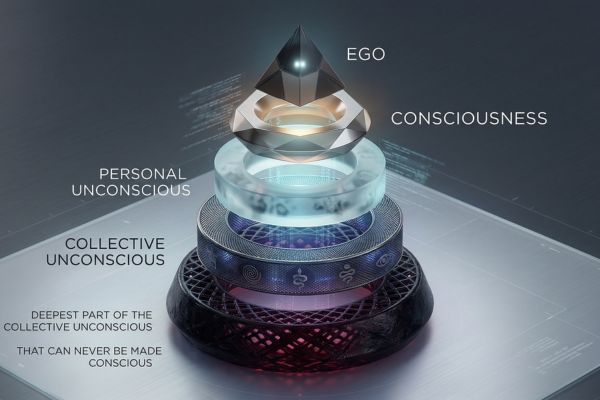
Consciousness
Let’s begin with the simplest part.
Consciousness is the part of the psyche that knows. It is what you are aware of. It includes your thoughts, perceptions, intentions, preferences, observations, and immediate sense of self. It is the part of you that can say, “This is what I think,” “This is what I want,” “This is what I remember,” or “This is what just happened.”
Consciousness allows you to orient yourself in the world. It helps you interpret experience, make decisions, form judgments, and interact with reality. It is how you participate in daily life.
It also has limits.
A lot of people overestimate consciousness because it is the part they can access most easily. They assume that because they can explain something, they understand it. That is rarely true. Insight is not the same thing as transformation, and explanation is not the same thing as freedom. You can know exactly why you do something and still keep doing it. You can have language for a pattern and still be caught inside it.
Consciousness matters, but it is not sovereign.
It is one voice in a larger system.
Still, it is an essential voice, because this is the level at which reflection becomes possible. Without consciousness, there is no observation. Without observation, there is no interpretation. Without interpretation, there is no meaningful astrological work. You cannot integrate what you cannot notice.
This is one reason astrology can be so useful. A good reading increases consciousness. It names patterns that are already active but not yet fully recognized. It gives form to something you may be living but not yet able to articulate. And once something can be named, it becomes easier to work with.
Not easy. Just easier.
The Ego
Now let’s talk about the ego, because this is one of the most abused words in spiritual and psychological conversation.
In popular culture, the ego is treated like a villain. It gets reduced to arrogance, vanity, selfishness, or the part of you that needs to be spiritually vaporized so you can ascend into some purified state of cosmic good manners. That idea does a lot of damage.
The ego is not the enemy.
The ego is the organizing center of consciousness. It is the part of the psyche that gives you continuity, coherence, and a functional sense of “I.” It allows you to move through the world as a person rather than as a loose cloud of impressions, impulses, memories, and reactions.
Without ego, there is no stable standpoint. There is no one there to reflect, to choose, to assess, or to respond. There is no center from which experience can be organized.
That means the ego has an important job. It helps regulate consciousness in several ways.
First, it gives a person continuity over time. It helps create a stable sense that the self who woke up this morning is connected to the self who made decisions last week, remembers what happened last year, and is still accountable for what comes next. Without that continuity, life becomes fragmented.
Second, it supports identity. Identity is not the whole psyche, but it matters. You need some workable sense of who you are in order to function in relationships, make commitments, and maintain a life. This identity will evolve, and it should evolve, but there must be enough coherence for you to feel that your life belongs to you.
Third, the ego helps with cognition. It processes information, evaluates experience, remembers, plans, compares, and interprets. It is involved in making sense of what is happening.
Fourth, it supports ordinary functioning. Paying bills, returning messages, taking care of your health, going to work, remembering appointments, handling responsibilities, making decisions under pressure, and staying oriented in daily reality all depend on ego strength.
Fifth, and this is a big one, the ego participates in reality testing. It helps you distinguish between what you feel, what you fear, what you imagine, and what is actually happening. That does not mean the ego is always right. It often is not. But a healthy ego helps you stay in contact with reality even when strong feelings are moving through you.
Astrologically, this matters because the chart is not just showing drives and potentials. It is also showing how a person holds themselves together. It reflects how identity forms, where coherence is strong, where it is fragile, and where the conscious self may have a harder time managing the material pressing up from underneath.
That is one reason astrology should never encourage ego annihilation. What people usually need is not less ego. They need a better relationship with it. They need an ego strong enough to face truth without collapsing, compensating, inflating, or turning every discomfort into a personal mythology of persecution.
A functional ego does not erase complexity. It helps you bear it.
The Unconscious
If consciousness is what you know, then the unconscious is everything that remains outside that immediate field of knowing.
That includes forgotten material, repressed experiences, emotional patterns, symbolic images, instinctive responses, unresolved conflict, latent tendencies, and aspects of the self that the conscious personality either cannot yet integrate or does not want to claim.
The unconscious is not just a storage closet for bad memories. It is not a psychic junk drawer. It is alive. It compensates for what consciousness ignores. It organizes emotional material. It influences perception. It shapes reaction. It produces dreams, fantasies, symptoms, projections, obsessions, attractions, aversions, and those moments when you say, “I do not know why I reacted that way,” even though some deeper part of you absolutely knows.
The unconscious is not irrational in the sense of being meaningless. It has its own logic. It speaks through image, mood, symbol, displacement, repetition, and emotional charge. It rarely shows up in a neat explanatory paragraph. It arrives sideways.
That is one reason people can be so confused by their own behavior. They assume they should always be able to explain themselves consciously. But much of psychic life does not enter awareness in a polite and orderly fashion. It breaks through in the places where your composure slips.
You say you are fine, but your body is clenched.
You say you have moved on, but you keep choosing the same person in a different costume.
You say you do not care, but your reaction says otherwise.
That is unconscious material at work.
In depth psychology, the unconscious is often discussed in two broad dimensions: the personal unconscious and the collective unconscious. That distinction is useful for astrologers because some chart material is highly personal and biographical, while some of it feels larger, older, and more impersonal, even when it is moving through your individual life.
Let’s take them one at a time.
The Personal Unconscious
The personal unconscious contains material that belongs specifically to you. It is made up of your experiences, memories, emotional residues, internalized relationships, unprocessed events, abandoned aspects of self, and everything that has been pushed outside the preferred image of who you believe yourself to be.
This is the part of the unconscious most closely tied to biography.
Your family dynamics live here.
Your private humiliations live here.
Your disappointments live here.
Your early conclusions about love, safety, power, value, visibility, and belonging live here.
The emotional shape of your history lives here.
That does not mean all of it is dramatic. Some of it is subtle. A single repeated message in childhood can settle into the psyche and start organizing perception without fanfare. You do not even notice it at first. It just becomes the lens.
Maybe you learned that being competent is how you earn love.
Maybe you learned that needing anything makes you weak.
Maybe you learned that desire creates danger.
Maybe you learned that conflict means abandonment.
Maybe you learned that success will cost you intimacy.
Maybe you learned that you only feel significant when something is wrong.
Those kinds of conclusions often become part of the personal unconscious. They do not just sit there as ideas. They gather emotional energy. They begin to organize expectation, behavior, and reaction. And eventually they form what psychology calls complexes.
Complexes
This is another word people love to misuse.
When most people say someone “has a complex,” they mean the person is difficult, insecure, dramatic, or irrational. But in depth psychology, a complex is not a cheap insult. It is an emotionally charged cluster of associations organized around a central theme.
In plain English, a complex is a living knot of feeling, memory, expectation, and reaction.
We all have them.
There is no gold star for being complex-free. That person does not exist.
You can have a mother complex, a father complex, a money complex, a success complex, a failure complex, a visibility complex, a relationship complex, a sexuality complex, a spiritual complex, a power complex. The themes vary, but the structure is similar: a cluster of emotionally loaded material gathers around a recurring life issue, and that cluster influences how you perceive and respond when the issue is activated.
Take the mother complex. This does not only refer to your literal mother as a person, although of course she matters. It includes your lived experience of mothering, nourishment, care, deprivation, emotional availability, inconsistency, engulfment, comfort, attachment, dependency, and need. It includes what was present and what was missing. It includes love and resentment, gratitude and injury, loyalty and hunger.
That entire field becomes psychically active.
So later in life, when someone nurtures you, withdraws from you, criticizes you, smothers you, or asks you to need them, you may not just be responding to the present moment. You may be responding with an entire emotional history.
That is a complex.
The same thing happens with money. A person who grew up in scarcity may react to financial instability with terror, shame, rigidity, overcontrol, overwork, magical thinking, or self-sabotage. It is not just about the current bill. It is about the whole emotional field constellated around survival, worth, helplessness, and memory.
That is why complexes matter so much in chart work. They explain why people do not always respond proportionally. They explain why intelligence does not always prevent reactivity. They explain why someone can be highly developed in one area of life and completely hijacked in another.
Because when a complex is activated, the person is not operating from neutral ground.
How Complexes Behave
Complexes are not passive. They do things.
They gather emotional energy.
They shape perception.
They bend interpretation.
They color expectation.
They intensify reactivity.
They narrow choice.
And when they are activated strongly enough, they can temporarily overwhelm the ego’s usual level of balance and perspective. A person who is normally thoughtful becomes impulsive. A person who is normally composed becomes flooded. A person who is usually grounded becomes suspicious, defensive, clingy, avoidant, or self-destructive.
This does not mean the person has become unreal. It means a different psychic center of gravity has taken over. This is called “complexing out.”
You have probably seen this in yourself.
You are fine until a particular topic appears.
Then suddenly you are not responding to what is in front of you. You are responding to something older, deeper, and more emotionally charged.
Maybe a partner takes too long to text back and you are no longer just mildly annoyed. You are spiraling into abandonment, humiliation, rage, or collapse.
Maybe a small professional setback does not just sting. It detonates a whole story about failure, worthlessness, exposure, and defeat.
Maybe a minor critique does not land as feedback. It lands as proof that you are fundamentally not enough.
That is a complex in motion.
The point is not to shame that. The point is to recognize it. Because once you can see a complex, you stop confusing it with truth. You begin to realize that some reactions are not just about the present event. They are shaped by a larger emotional pattern.
Astrology is very good at showing where these patterns live.
We see them in hard aspects, in repetitions, in signatures involving Saturn, Pluto, Chiron, the Moon, Venus, Mars, the 4th house, the 8th house, the 12th house, and many other configurations depending on the chart. Not because these placements automatically equal pathology, but because they often describe the places where psychic material is charged, defended, compensated for, or pushed underground.
The chart does not “cause” the complex. It symbolizes the structure through which the person is likely to experience and organize certain psychological themes.
That distinction matters, because astrology is not a diagnosis. It is symbolic description.
But through thoughtful analysis, symbolic description can become psychologically revealing in a way that feels almost surgical.
The Collective Unconscious
Now we move deeper.
The personal unconscious belongs to your history. The collective unconscious belongs to the deeper human inheritance beneath personal biography.
This is where things get more archetypal.
The collective unconscious is not about the story of your particular mother, father, heartbreak, ambition, or humiliation, although those personal stories may carry it. It refers to the deeper symbolic patterns that structure human life more broadly. Birth. death. separation. union. rivalry. sacrifice. exile. hunger. initiation. loss. desire. transformation. power. betrayal. devotion. fate.
These are not just events. They are fundamental human patterns.
This is why certain myths endure, why certain symbols repeat across cultures, and why human beings keep telling the same stories in different clothes. Something in the psyche is organized archetypally. Something in us responds to motifs that are larger than our personal biography because they belong to the architecture of being human.
Archetypes are not stereotypes and they are not costumes. They are not a mood board. They are deep patterning principles. They show up in myth, religion, fantasy, literature, dream, art, and of course astrology.
The mother is an archetype.
The father is an archetype.
The child, the lover, the exile, the king, the destroyer, the trickster, the guide, the martyr, the avenger, the sacred whore, the wanderer, the orphan, the reborn self. These are all archetypal forms.
You never meet an archetype in a pure state. You meet it embodied through people, experiences, symbols, fantasies, projections, and stories. But the force behind it is larger than the individual instance.
That is why working with your chart can feel so profound. Your chart does not just describe your habits. It often reveals the archetypal drama a person is living through.
Some people are living a Persephone story and do not know it.
Some are living an Icarus story.
Some are carrying Antigone.
Some are in a Saturnian struggle with authority, time, and legitimacy.
Some are in a Neptunian crisis of dissolution, sacrifice, idealization, or longing.
Some are in a Plutonian passage involving loss, power, descent, compulsion, and rebirth.
And once you see the archetypal field, the life starts making a different kind of sense.
Not always a comfortable sense. But a deeper one.

Archetypes and Astrology
Astrology is one of the most sophisticated symbolic systems ever devised for reading archetypal patterning.
The planets are not just “things that happen.” They are living symbolic principles. Each one describes a mode of psychic life, a style of experience, a form of desire, conflict, function, or development. Houses show where those dynamics tend to constellate in lived experience. Aspects show tension, dialogue, compression, compensation, and release between different parts of the psyche.
This is why astrology works so well in psychological interpretation. It does not flatten life into behavior alone. It keeps one foot in experience and one foot in symbol.
The chart lets us read both the personal and the archetypal at the same time. It’s both predictive and psychological.
The Moon can describe your mother story, your attachment history, and your instinctive emotional style, but it also taps a deeper archetypal field of care, dependency, memory, regulation, hunger, and belonging.
Saturn can describe a familial wound, authority issues, fear of failure, shame, inhibition, or overresponsibility, but it also reflects a larger archetypal reality involving structure, law, time, limitation, maturity, and consequence.
Pluto can describe literal experiences of loss, control, violation, obsession, power struggle, or deep transformation, but it also constellates the archetypal descent, the underworld journey, death-and-rebirth processes, the confrontation with the irreducible.
Neptune can show confusion, permeability, idealization, surrender, addiction, spiritual hunger, artistic imagination, or longing for transcendence, but behind those experiences is a much larger archetypal field involving dissolution of form and the seduction of the infinite.
Uranus can describe rupture, liberation, disruption, rebellion, awakening, unpredictability, and the need to individuate beyond conditioning. It is often where the psyche refuses imprisonment.
And the 12th house, in particular, often shows where the personal life opens into transpersonal material. It is not just secrets and hidden enemies, and frankly astrology has done enough damage with that nonsense. The 12th often describes material that is difficult to consciously grasp because it belongs to a deeper field: ancestral residue, psychic inheritance, sacrifice patterns, dissolution, withdrawal, symbolic life, the invisible pressure of what has not yet been fully known.
It is one of the places where the personal psyche brushes up against something much older and less easily controlled.
The Body
No serious psychological model is complete if it leaves the body out of the conversation.
The body is not separate from the psyche. It is one of the ways the psyche speaks.
That does not mean every physical condition has a neat symbolic cause, and it does not mean we should turn illness into moral theater or pretend every symptom is a spiritual metaphor waiting to be decoded on Instagram by someone with a ring light and no restraint. But it does mean that psychic life is embodied. We live our histories physically. We hold tension physically. We brace physically. We collapse physically. We harden, numb, constrict, inflame, exhaust, and overcompensate physically.
What is not processed inwardly often shows up behaviorally, relationally, or somatically.
Stress changes posture.
Fear changes breath.
Shame changes visibility.
Grief changes vitality.
Hypervigilance changes the way a person moves through the world.
Long-term emotional strain affects appetite, sleep, energy, sexual expression, attention, and resilience.
The body is not a side note to psychological life. It is one of its primary stages.
This is important when analyzing your chart, because there are experiences you can feel but not yet fully explain. You may say things like:
“I know something is wrong, but I cannot name it.”
“I feel shut down.”
“I keep freezing.”
“I am tired all the time.”
“I feel like I disappear in relationships.”
“My anger goes straight into my body.”
“I cannot relax even when nothing is happening.”
Those statements matter. They are not just complaints. They are information.
Astrology can help contextualize those experiences by showing where pressure, conflict, suppression, permeability, overextension, and unresolved patterning may be at work. But we need to be responsible about how we talk about that. Astrology can illuminate psychological dynamics. It can support reflection. It can help a person understand their symbolic and emotional process. It can complement therapy beautifully. But it is not a replacement for medical care, trauma treatment, or skilled mental health support when those are needed. There is a difference between symbolic insight and professional overreach.
The symbolic element remains significant. The body frequently conveys aspects that the conscious personality has yet to acknowledge. As individuals gain insight into the psychological patterns influencing their lives, tensions within the body may ease—not due to any magical properties attributed to astrology, but because enhanced awareness alters one’s relationship with the body. Changes in relationships lead to different responses, and those responses ultimately influence life outcomes.
So, if you discover that you need help to resolve issues that the chart reveals, please do yourself a favor, and get it.
Why This Matters for Astrology
You cannot understand your chart well if your entire model of the human being is superficial.
If your only question is “What does Venus in Scorpio mean?” then you will always stop too soon. The better question is: how does this Venus function inside the structure of the psyche? What does it defend? What does it want? What does it fear? What history might it carry? What complexes gather around it? What archetypal story is trying to come through it? Where is it conscious, and where is it not?
That is how you get the most out of your chart.
Astrology is not strongest when it is reduced to labels. It is strongest when it becomes a language for describing psychic process.
The horoscope can reveal where a person identifies consciously and where they are being unconsciously compelled. It can show the difference between the image someone has of themselves and the deeper pattern they are actually living. It can reveal conflict between adaptation and desire, between stability and change, between persona and shadow, between what was required for survival and what is needed for wholeness.
And perhaps most importantly, astrology can give people a way to approach themselves with more honesty and less contempt.
That matters because so much suffering is intensified by self-condemnation. People think their reactivity means they are weak. They think their contradictions mean they suffer from imposter syndrome. They think their pain means they are broken. A psychological approach to astrology does not excuse behavior, but it does contextualize it. It helps people understand that there is structure to their inner life. There is meaning in the pattern. There is a reason certain themes repeat. There is a logic to what feels chaotic.
Not a simplistic logic. Not a cruel one. But a real one.
And when you can understand the pattern, you are no longer standing in the dark insisting that your suffering is random.
Final Thoughts
The point of learning a psychological model of the psyche is not to become abstract, clinical, or self-important. It is to become more accurate.
It is to stop pretending that people are simple.
It is to stop reading your chart like a personality quiz in Cosmo.
It is to stop confusing symbolism with prediction alone.
It is to stop mistaking surface behavior for the whole truth.
When you are working with your chart, you are not just working with a list of your placements. You are bringing your psyche along for the ride. You are working with your history, structure, your way of coping, your desires, your wounds, defenses, and your personal mythology, and try to emerge through all of it.
That deserves more than canned meanings.
It deserves depth.
It deserves psychological honesty.
It deserves symbolic intelligence.
It means looking at astrology as one who understands that the chart is not just describing a life. Astrology describes the inner architecture through which that life is being lived.
And once you begin to see the psyche that way, astrology stops being just a fun app on your phone.
It becomes diagnostic in the symbolic sense, reflective in the deepest sense, and transformative in the way that actually matters, because it helps people recognize what they are living, what is living them, and where real change becomes possible.