There are people who regard Saturn with approximately the same enthusiasm they would reserve for an unexpected visit from the Internal Revenue Service. Simply mention that Saturn is making an important transit, and their expressions immediately change. They begin anticipating disappointment, deprivation, financial problems, or some dreadful event that will require several years of therapy to properly understand. Mars doesn’t fare much better. He’s blamed for arguments, accidents, anger, and just about every unpleasant confrontation people would prefer to avoid. Meanwhile, Jupiter and Venus enjoy considerably more favorable reputations, frequently receiving enthusiastic welcomes from people who assume that the arrival of a benefic planet means something wonderful is about to happen.
I’ve always found this attitude rather peculiar, especially among people who practice planetary magic. If you’re willing to approach the gods as distinct powers capable of influencing earthly circumstances, it seems reasonable to understand what those powers actually do. Unfortunately, much of the contemporary conversation surrounding planetary magic treats the traditional benefic and malefic classifications as though they were moral judgments. Jupiter and Venus become the nice gods who bring presents, while Mars and Saturn are relegated to the celestial equivalent of the disciplinary committee.
The inconsistency becomes particularly amusing when you consider how practitioners actually behave. I’ve known people who become visibly uncomfortable at the thought of working with Saturn, even when they’re trying to establish stability or overcome a difficult situation. I’ve also encountered people who are perfectly comfortable hexing someone over an insult that most adults would have forgotten by lunchtime. Apparently, Saturn is terrifying until somebody fails to return a phone call, at which point invoking his restrictive powers suddenly becomes remarkably appealing.
After more than twenty-five years of practicing planetary magic, I’ve developed a different understanding of these distinctions. I believe that archetypal energies are fundamentally amoral. They express particular qualities and powers, and those powers can manifest through circumstances that human beings experience as helpful, destructive, desirable, or profoundly unpleasant. The moral responsibility belongs to the people choosing how to engage with them.
This doesn’t mean traditional astrology was mistaken to classify certain planets as benefics and others as malefics. Those distinctions have a long history and a legitimate place within astrological practice. But understanding why Mars and Saturn acquired their reputations requires considerably more than deciding that some gods are good and others are bad.
Why Astrology Has Benefics and Malefics
The traditional classification of planets as benefic or malefic emerges from an ancient understanding of the natural world in which heat, cold, moisture, and dryness possessed particular qualities. These ideas formed part of the philosophical and medical frameworks through which ancient astrologers understood celestial influence.
In the Tetrabiblos, Claudius Ptolemy associates Jupiter and Venus with temperate conditions involving warmth and moisture, qualities understood to promote nourishment and growth. Saturn, by contrast, is associated with excessive cold, while Mars is associated with excessive dryness. These qualities were thought to produce conditions more likely to diminish, separate, or destroy.
The classification therefore concerned the characteristic effects attributed to the planets within a particular system of natural philosophy. It wasn’t simply an assessment of their personalities or a declaration that Saturn had committed some unforgivable offense against humanity.
Traditional astrologers also recognized that planetary conditions could modify these effects. Essential dignity, house placement, aspects, and sect all contributed to the interpretation of a planet’s influence. Saturn belongs to the diurnal sect and Mars to the nocturnal sect, distinctions that could moderate their more difficult expressions under appropriate circumstances. Neither planet was understood as operating identically in every horoscope.
Planetary magic introduces another consideration. When we approach a planetary deity, we’re attempting to engage particular qualities of that planet for a specific purpose. A power associated with restriction may be useful when restriction is precisely what a situation requires. A planet associated with conflict may be appropriate when someone needs the courage to compete or defend themselves.
The traditional classifications remain meaningful, but their practical significance depends upon understanding the powers we’re asking the gods to exercise.
Mars: The God You Want on Your Side
 Mars is one of the easiest planetary gods to misunderstand because his symbolism involves activities that many people find uncomfortable. Competition, confrontation, aggression, and conflict can produce destructive consequences, and the ancient mythology of Ares certainly offers little reason to regard him as a charming dinner companion.
In Homer’s Iliad, Ares is frequently portrayed as a violent and unruly figure associated with the terrifying experience of warfare. His mythological companions include Phobos and Deimos, Fear and Dread, whose names are hardly reassuring. Yet courage and the ability to confront danger were necessary qualities in the ancient world, just as they remain necessary today.
In planetary magic, I’ve found Mars particularly useful when someone needs strength, ambition, confidence, or the determination to prevail in a competitive situation. One of my favorite practical applications of Mars is employment.
Think about what happens when someone applies for a desirable position. Their résumé may be competing with dozens or hundreds of other applications. They need to attract attention, demonstrate their qualifications, and convince someone that they’re the appropriate candidate. They may also need to negotiate a salary or distinguish themselves from equally qualified applicants.
These are competitive circumstances, which makes Mars a perfectly reasonable deity to approach.
A Martial petition might focus on helping someone’s résumé rise above the competition, bringing the applicant to an employer’s attention, or providing the confidence necessary to perform well during an interview. Within my practice, these are constructive applications of Mars’s power. Someone hoping to prevail over other applicants isn’t necessarily wishing harm upon anyone. They’re attempting to succeed in a situation where competition is already part of the process.
I’ve also recommended Mars when someone needs the courage to confront an intimidating person, defend themselves, or make a difficult decision they’ve been avoiding. In these circumstances, I want the petitioner to be very clear about the result they’re seeking. A request for courage differs considerably from a request to defeat an enemy, and the petition should reflect that distinction.
Mars can certainly be invoked in aggressive magical operations. His traditional associations with warfare make that possibility difficult to ignore. But I’ve never understood why we should limit ourselves to his destructive expressions when those same Martial powers can help someone develop the determination necessary to accomplish something worthwhile.
However, sometimes life demands confrontation, even when we’d much rather avoid it.
Saturn: The Power to Say Enough
 Saturn presents a different problem because his reputation is closely associated with deprivation, limitation, hardship, and the passage of time. People frequently approach him as though he were an unpleasant authority figure determined to confiscate everything that makes life enjoyable.
I’ll admit that I once found Saturn rather intimidating myself. What astrologer hasn’t?
When I first began studying astrology, I was considerably more interested in the possibilities represented by Jupiter and the Sun. Saturn’s emphasis on discipline, responsibility, and restriction wasn’t especially attractive, particularly when those qualities appeared to interfere with something I wanted.
Over the years, however, I began appreciating the importance of structure, endurance, and the ability to build something that could withstand ordinary difficulties. I also developed a greater respect for his association with tradition and the wisdom acquired through experience.
Someone who struggles with discipline might approach Saturn to establish more consistent habits. A person hoping to develop professional authority or earn greater respect could petition him for assistance in cultivating the qualities that support those objectives. Saturn can also be useful when someone is establishing a business, building a long-term foundation, or attempting to create stability in circumstances that have become difficult to manage.
These applications make sense because discipline requires accepting limitations, and lasting accomplishments generally involve responsibilities that cannot be avoided.
Saturn’s relationship with boundaries is equally important, particularly in defensive magic.
This is where I distinguish Saturn from Mars. If I need courage or strength to confront a difficult situation, Mars is generally the planetary power I would approach. If I need to establish a boundary and prevent someone from continuing harmful behavior, Saturn may be more appropriate.
I don’t casually recommend binding magic, and I have little interest in practitioners who respond to every personal grievance by attempting to hex someone. Nevertheless, I don’t believe defensive magic should be dismissed simply because it involves restrictive powers.
If someone threatens me or the people I love, I’m prepared to approach Saturn for protection. My objective would be to stop the harmful behavior rather than punish the person for the satisfaction of watching them suffer. The petition would establish what needs to be restricted and why, while ordinary protective measures would remain equally important.
There’s a reason I named my Astro Magic Saturn candle Get the F— OUT!
The name reflects the kind of boundary that occasionally becomes necessary. Someone may have exhausted every reasonable opportunity to resolve a situation, and the time has come to remove an unwanted influence from their life. Saturn’s restrictive qualities make him appropriate to that operation without requiring us to imagine that he’s inherently evil.
His mythology is also considerably richer than his reputation suggests. Although Saturn became associated with aging and limitation in astrology, Roman tradition remembered his reign as the Golden Age, a period characterized by peace and abundance. The Saturnalia festival preserved aspects of that association through celebration and the temporary relaxation of ordinary social conventions.
It’s a fascinating complication in the story of a god who is so frequently portrayed as the celestial authority responsible for making everyone’s life miserable.
Saturn’s powers can establish uncomfortable limitations, but they can also provide the foundations upon which something valuable develops. I’ve learned to appreciate both possibilities rather than expecting him to behave like a particularly disagreeable school principal.
Jupiter: Be Careful What You Ask to Expand
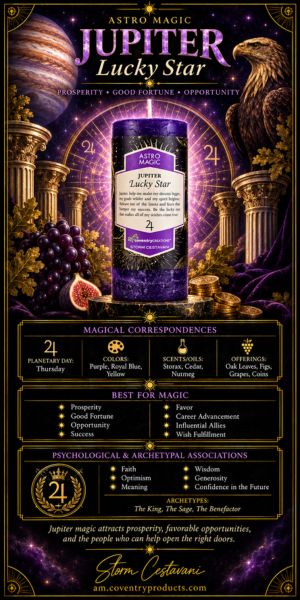 Jupiter enjoys a reputation that would make most public relations professionals envious. He’s associated with prosperity, opportunity, generosity, expansion, and good fortune. People approach him with considerable enthusiasm, particularly when they’re seeking financial improvement or professional advancement.
And I understand why. Jupiter is one of my favorite planetary powers when someone needs opportunities, assistance, or the possibility of improving their circumstances.
But the word expansion deserves careful consideration.
Years ago, I encountered a client who had performed a Jupiter working because they wanted to live a more abundant life. Their petition was broad, with little consideration given to the specific circumstances they hoped to improve.
They subsequently experienced an increase in money and financial resources, which was certainly consistent with what they had requested. However, they also gained a considerable amount of weight.
I interpreted the experience as a striking illustration of why petitions involving Jupiter need to be specific. The client had asked for abundance without clearly identifying what they wanted to increase, and the developments they reported included both a desired financial improvement and a bodily change they hadn’t welcomed.
Of course, a magical working cannot be established as the medical cause of someone’s weight gain. What interested me was how closely the reported circumstances resembled the broader symbolism of Jupiterian expansion, including its capacity for excess.
More isn’t always better, particularly when someone hasn’t considered what they’re prepared to accommodate.
A person may experience a substantial increase in income while simultaneously developing spending habits that leave them in a worse financial position than before. Someone who receives additional opportunities may discover that the responsibilities accompanying those opportunities exceed their capacity to manage them. Generosity itself can become problematic when it operates without proportion or judgment.
These are recognizable expressions of Jupiter’s symbolism, although their occurrence doesn’t automatically establish a magical cause.
When someone approaches Jupiter, I encourage them to identify the specific kind of growth they’re seeking. A petition for greater financial security has a more defined purpose than a general request for an abundant life. This is significant because the practitioner should have considered what achieving the desired result would actually involve.
Jupiter may be a benefic, but I wouldn’t approach him carelessly simply because expansion sounds appealing.
Venus: Love Can Become a Very Unpleasant Business
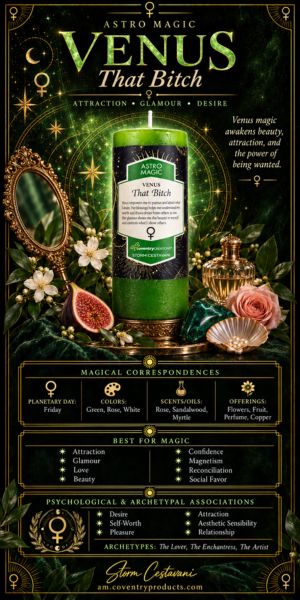 If Jupiter’s difficulties involve excess, Venus presents another problem entirely. Her powers concern love, attraction, desire, pleasure, beauty, and the bonds that draw people toward one another. These qualities are generally regarded as desirable, which helps explain why Venus is one of the most popular deities in planetary magic.
Unfortunately, Aphrodite’s mythology should be sufficient to convince anyone that love and good judgment are not always on speaking terms.
Consider the Judgment of Paris. Eris introduced a golden apple intended for the fairest goddess, provoking a dispute involving Hera, Athena, and Aphrodite. Paris was appointed to judge the contest, and Aphrodite secured his favor by promising him Helen. The consequences contributed to the events leading to the Trojan War.
It’s a rather spectacular example of attraction becoming entangled with rivalry, possession, and disastrous decisions. Aphrodite may be a goddess of love, but she has never shown much interest in behaving like a relationship counselor.
I’ve encountered similarly troubling complications in contemporary Venusian workings.
In one situation, a woman performed magic intended to bring back a partner who had repeatedly strayed from the relationship. Her petition went considerably beyond requesting a reconciliation. She wanted him to become obsessed with her and sexually interested in nobody else.
According to the circumstances later described to me, the relationship became increasingly difficult. The man exhibited intense jealousy and possessiveness, his sexual demands became overwhelming, and his behavior approached abuse.
I encountered the situation after the working had already been performed, so I wasn’t involved in preparing the petition. Nor would I claim that the magic caused his behavior. He remained responsible for his actions, and nobody should be held responsible for another person’s abusive conduct simply because they previously wanted the relationship to continue.
What disturbed me was the difference between the kind of relationship the woman appeared to want and the qualities she had actually requested.
Obsession can feel flattering when someone fears abandonment. A person who has experienced repeated infidelity may imagine that exclusive sexual interest will resolve the insecurity created by the relationship. Yet possessiveness can become profoundly destructive, particularly when someone begins treating another human being as something they own.
Had I been asked to help prepare the petition beforehand, I would have encouraged her to consider what kind of relationship she genuinely wanted. A loving, faithful, mutually satisfying partnership would be a considerably more productive objective than attempting to produce obsessive attachment in someone whose behavior had already created serious difficulties.
The problem wasn’t that she had approached Venus. It was that her petition reflected a desire to control another person’s attachment rather than establish the qualities of a healthy relationship.
This is why I become concerned when people assume that Venusian workings are automatically harmless because Venus is traditionally considered a benefic. Desire can become entangled with jealousy, insecurity, and the fear of abandonment. The presence of those feelings doesn’t make someone morally deficient, but they deserve examination before becoming the basis of a magical request.
Aphrodite has a remarkably complicated history, and anyone who imagines she’s interested exclusively in arranging happy marriages probably needs to spend more time reading Greek mythology.
Beyond Good and Evil: Developing Relationships with the Gods
The experiences I’ve described illustrate why I regard the planetary archetypes as fundamentally amoral. Their powers can manifest through circumstances that we experience very differently depending upon our needs, choices, and the situations we’re attempting to influence.
Even Eris, whose mythology concerns discord, cannot be reduced to evil simply because discord makes people uncomfortable. Conflict can expose a problem that everyone has been attempting to ignore, although it can also produce considerable suffering. The circumstances determine whether its consequences prove useful or destructive.
The same principle applies to the seven classical planets. Mars’s capacity for confrontation can support courage or aggression. Saturn’s restrictions can establish necessary boundaries or impose destructive limitations. Jupiter can provide welcome opportunities while also encouraging excess, and Venusian attraction can contribute to a loving relationship or become entangled with possessiveness.
I don’t believe the gods require us to pretend their difficult qualities don’t exist. In fact, those qualities are often precisely why we approach them.
This doesn’t mean that every magical action is ethically equivalent. Someone who deliberately attempts to harm another person over a minor grievance has made a choice that deserves scrutiny. Claiming that Mars or Saturn possesses destructive powers doesn’t absolve the practitioner of responsibility for how those powers are employed.
Nor do I believe that defensive magic should be automatically condemned. There are circumstances in which someone may have legitimate reasons for seeking protection through the magical methods available within their tradition. The purpose of the working, the seriousness of the situation, and the consequences being sought all deserve consideration.
My own approach has also changed through developing relationships with the planetary gods over many years.
When someone first encounters Saturn in an introductory astrology book, they’re usually given a relatively limited description of his powers. He governs restriction, hardship, discipline, and the passage of time. Those associations are useful, but they cannot adequately convey the complexities that emerge through experience.
My relationship with Saturn has taught me to appreciate qualities I once found intimidating. Discipline becomes more meaningful after you’ve experienced the consequences of lacking it. Boundaries become more important after you’ve encountered people who repeatedly disregard them. Patience begins to make sense when you’ve watched something valuable develop over a period that couldn’t reasonably have been shortened.
I believe that working with a planetary deity over time allows someone to develop a more comprehensive understanding of that planet. There’s also a threshold of familiarity that develops through experience. The practitioner may become more comfortable engaging difficult planetary qualities and more discerning about the circumstances in which those powers should be employed.
This doesn’t mean every working becomes successful or that someone acquires unlimited control over a planetary deity. Familiarity can improve judgment, but it doesn’t eliminate the possibility of mistakes.
Nor does developing a relationship with Saturn remove the difficult features of someone’s natal Saturn configuration. The horoscope remains what it is. What may change is the person’s understanding of the planetary symbolism and their ability to work constructively with the qualities already present in their life.
Someone who once experienced Saturn primarily through frustration may eventually recognize his significance in developing professional authority, establishing boundaries, or sustaining an important commitment. The symbolism remains recognizable, but the person’s relationship with it becomes considerably more sophisticated.
This is one reason I encourage practitioners to study mythology and cultivate relationships with the gods beyond the immediate needs of a magical working. Their histories and personalities are much richer than the brief descriptions attached to astrological keywords, and those stories can complicate our assumptions about what a particular planetary power represents.
After more than twenty-five years of practicing planetary magic, I’m less interested in categorizing the gods according to whether they make people comfortable. I want to understand what they govern, how their powers can be approached, and whether I’m prepared to accept responsibility for what I’m asking them to accomplish.
If someone needs courage to compete for employment, Mars may be appropriate. If they need discipline, stability, or protection from unwanted interference, Saturn may be the better choice. Jupiter can be approached for opportunity and expansion, while Venus may be appropriate for love, attraction, and relationships. Each petition deserves careful consideration because the practitioner should understand what they’re requesting and why.
Ultimately, I think the question of whether Mars and Saturn are bad planets tells us more about our expectations than it does about the gods themselves. Human beings tend to welcome powers associated with pleasant experiences while fearing those connected with obstacles or limitations. Yet our preferences aren’t reliable measures of a planet’s usefulness, and they certainly aren’t sufficient grounds for assigning moral character to an archetype.
The gods have their powers, and those powers deserve respect. We have our choices, including the responsibility to decide how and why we engage with them.
And if you’re going to ask Saturn to remove someone from your life or Mars to help you prevail over the competition, it would be wise to understand exactly what you’re asking.
After all, the Gods been doing their jobs for a very long time. It seems only fair that we do ours.